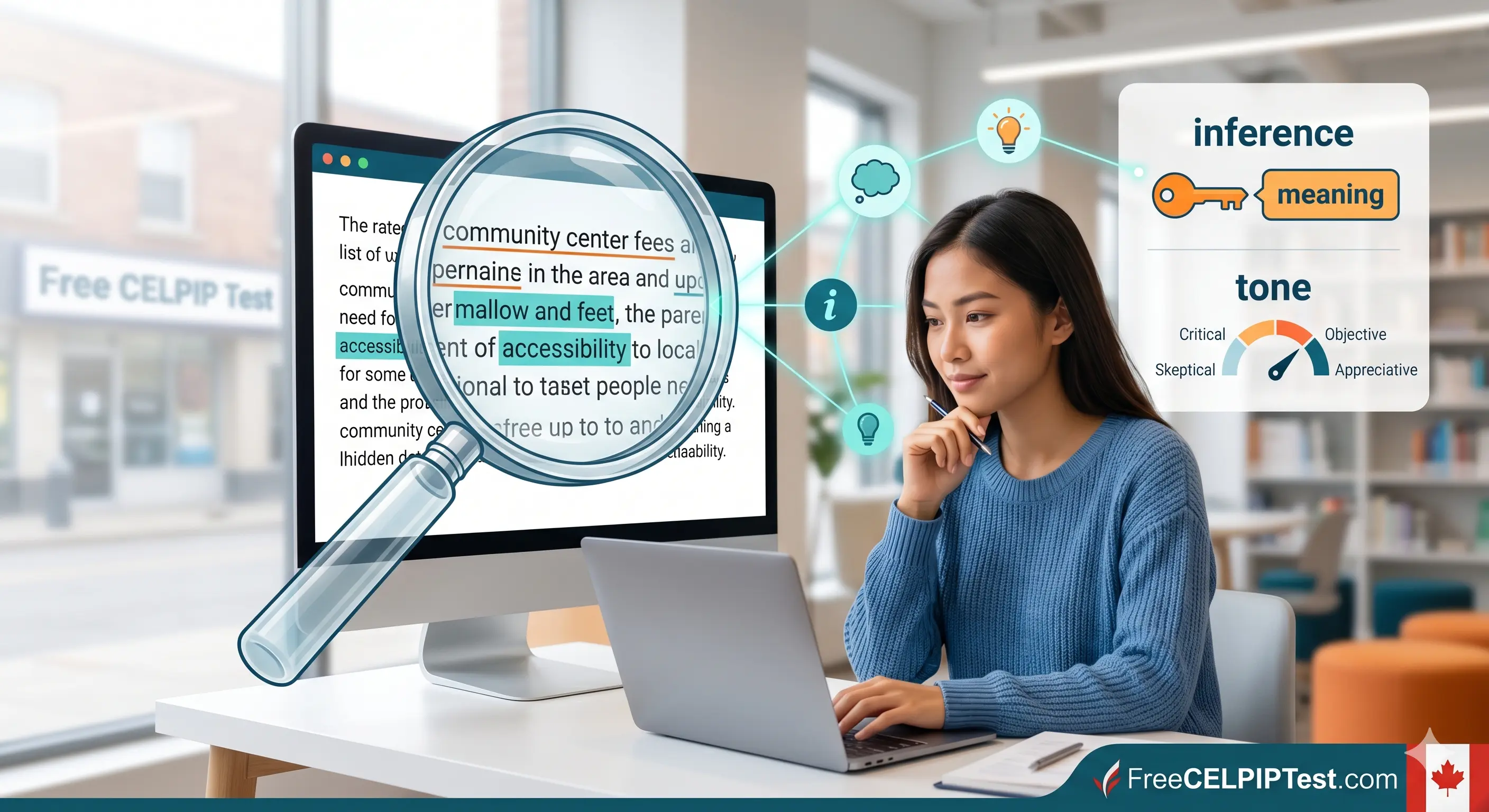
Reading Between the Lines: How to Master Inference & Tone in CELPIP Reading
Part 3 and Part 4 often test inference and tone—not just literal meaning. Learn a practical tone cheat sheet and a timed three-step map for CELPIP Reading.
Do you ever feel like you understood every word in a CELPIP Reading passage, but you still got the answer wrong?
You aren't alone. In Part 3 (Reading for Information) and Part 4 (Reading for Viewpoints), the CELPIP test stops asking you what happened and starts asking you why it was said or how the writer feels. This is called Inference.
1. What exactly is "Inference"?
Inference is the ability to understand a fact that is not explicitly stated.
Example: Text: "The city council’s new transit plan was drafted in a weekend without consulting local urban planners."
Question: What is the author’s attitude toward the plan? Answer: They are likely critical or skeptical.
The Clue: The phrase "without consulting" suggests a lack of thoroughness, even though the word "bad" is never used.
2. The "Tone" Cheat Sheet
In Part 4, you will often have to choose a word that describes a person's viewpoint. Memorize these high-value "Tone Words":
| Tone Word | Meaning | Context Clue |
|---|---|---|
| Objective | Unbiased; just the facts. | Uses statistics, no "I think" or "should." |
| Skeptical | Doubting the truth. | Uses words like "purported," "alleged," or "questionable." |
| Appreciative | Grateful or positive. | Focuses on benefits and successful outcomes. |
| Critical | Finding fault. | Focuses on gaps, risks, or missed opportunities. |
| Ambivalent | Having mixed feelings. | Mentions both pros and cons with no clear winner. |
3. Strategy: The "Three-Step Map"
Don't read the whole text first. You will run out of time. Follow this workflow:
- Paragraph Skim (30 Seconds): Read the first sentence of every paragraph. Write one word next to it (e.g., P1: History, P2: Risk, P3: Solution).
- Identify the "Attitude Anchors": Look for adjectives and adverbs. Words like "Unfortunately," "Remarkably," or "Shockingly" are your biggest clues for tone.
- The "Eliminate the Extreme" Rule: CELPIP answers are rarely "aggressive" or "hateful." If an answer choice is too extreme (e.g., "The author despises the project"), it is usually a distractor. Look for more moderate words like "disagrees" or "is concerned."
4. Interactive Challenge: Test Your Instincts
Read the short snippet below and answer the question in your head.
"While the new community center offers modern amenities, the membership fees are positioned at a price point that many local families may find difficult to justify given the current economic climate."
Question: Which statement best describes the writer’s viewpoint?
- A) The writer thinks the community center is a total failure.
- B) The writer is concerned about the accessibility of the center.
- C) The writer believes the amenities are not modern enough.
- D) The writer is excited about the economic growth the center brings.
Correct Answer: B.
Why? The writer uses the "sandwich technique"—starts with a positive ("modern") but uses the pivot word "While" to introduce their real concern: the price.
Pro-Tip for 9+ Scorers
In Part 3, if you can’t find the answer in paragraphs A, B, or C, it’s likely E (Not Given). Don't waste three minutes hunting for a ghost!
Ready to practice? Head over to our Free Practice Tests section and try a timed Part 4 set today.