Speaking Tips
The Speaking Mentor: Why the CELPIP Screen is Your Secret Weapon to Level 11
Use the CELPIP on-screen setup instead of fighting it: cut noise, manage the timer, and keep delivery clear when the speaking room feels high-pressure.
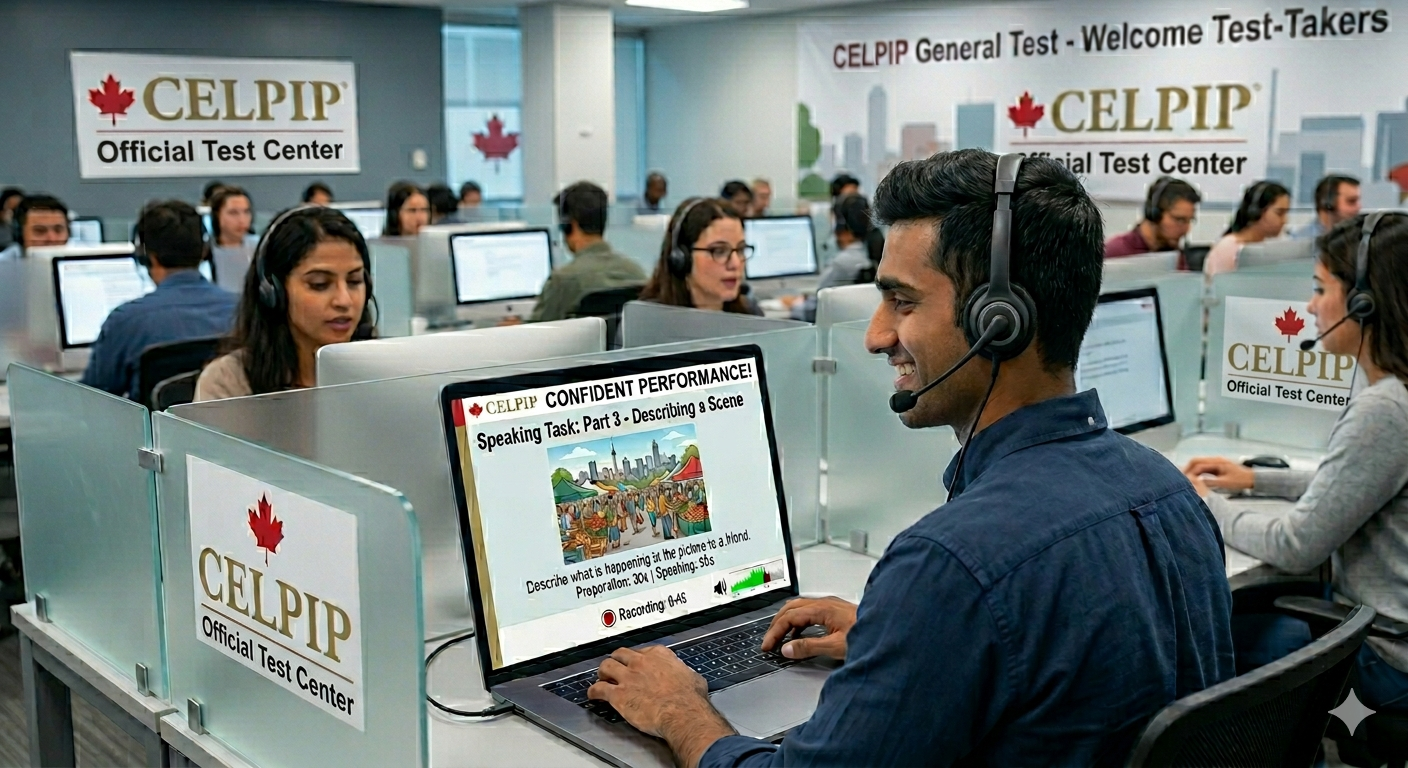
You're Sitting in a Test Center. The Headset Is On.
Around you, ten people are speaking about their "memorable vacations" and "favorite hobbies." You hear fragments of their answers in the background. Your turn comes. The screen starts counting down: 30 seconds prep.
Your heart races. The noise. The timer. The weird feeling of talking to a screen.
This is what separates CELPIP from a live IELTS interview. And if you're anxious about it, you're not alone.
Mentor note: Here's what I've learned after coaching dozens of high-band speaking candidates: The computer-based format isn't a disadvantage—it's a weapon if you know how to use it.
Unlike a live interview where someone watches your face and reads your body language, the CELPIP-style screen setup only records your voice. That means less surface for appearance-based bias. Your only job is to sound clear and thoughtful—not to manage a human interaction.
Learners who train for the format (not against it) often improve because they control the pace, use prep time strategically, and treat long silence as a problem to avoid, not as a normal thinking pause.
Why Computer-Based Speaking Works in Your Favor
In an IELTS interview, a human examiner watches your facial expressions, judges your confidence, and can cut you off if they're rushed. That's pressure.
In CELPIP, the screen is neutral:
- No bias: The computer doesn't care if you look nervous or have an accent. It only records what you say.
- Consistent timing: The timer is your coach, not your enemy. You always know exactly how long you have—no surprises.
- Psychological safety: There's no human interaction to navigate. You can focus 100% on being clear and fluent, not on "reading the room."
- Rescue phrases work: Natural filler phrases buy you time without sounding evasive (more on this below).
The shift in mindset: You're not being judged by a person. You're being scored on listenability—clarity, fluency, vocabulary range, and grammatical accuracy. Those are skills you control.
Let's map out the entire speaking test so you know exactly what you're facing.
The 8 CELPIP Speaking Tasks (At a Glance)
| Task | What You Do | Prep | Speak | The Skill Being Tested |
|---|---|---|---|---|
| 1: Advice | Suggest a solution to a friend | 30s | 90s | Sounding natural + helpful |
| 2: Story | Tell a personal story about a past event | 30s | 60s | Narrative fluency + detail |
| 3: Describe | Paint a picture using spatial language | 30s | 60s | Vocabulary + organization |
| 4: Predict | Speculate on an image's next moment | 30s | 60s | Hedging (might, is likely to) |
| 5: Compare | Choose between two things + justify | 60s | 60s | Logic + confidence |
| 6: Conflict | Negotiate a difficult situation | 60s | 60s | Empathy + firmness |
| 7: Opinion | Build an argument on a social issue | 30s | 90s | Structured reasoning |
| 8: Describe Object | Explain a complex object by phone | 30s | 60s | Clarity under constraints |
Total test time: ~15–20 minutes
Key insight: Tasks 1, 7, and 8 give you the most speaking time (90 seconds each). These are your "scoring power zones"—when you're solid here, they lift your overall band score more than nibbling at easier 60-second tasks.
Now let's tackle the biggest complaint: the noisy room and how to stay focused.
Surviving the Noisy Room (Three Techniques)
The #1 complaint is the noise of other test-takers speaking at once. But here's the truth: you can't eliminate the noise, you can only control your reaction to it.
Technique 1: The Headset Bubble
- Treat the headset like a soundproof shield
- When other voices come through, imagine they're outside your bubble
- Focus on your own breathing and voice inside the headset
- Your job: Stay inside your answer, not outside listening to theirs
Technique 2: The Anchor Word
- As you hear noise, silently repeat your prep notes (3–4 anchor words from the question)
- This keeps your brain on your own task
- When the noise fades and you're prompted to speak, you're already warmed up
- Example: If the task is "Describe a leader you admire," your anchor words might be: "confident, transparent, team-builder"
Technique 3: The Countdown Focus
- When noise spikes, shift focus to the timer counting down
- Make the timer your anchor instead of the noise
- Mentally: "30 seconds left → I'm prepping now → noise doesn't matter"
- By the time you're speaking, you're locked in
Room Control Mindset: Treat the test room like background noise on a podcast. Your job is not to eliminate it. Your job is to stay inside your own answer. That's when high scores happen.
The 30-Second Brain Dump (How to Use Prep Time Like a Pro)
You get 30–60 seconds (depending on the task) to prepare. Most test-takers waste this time staring at the screen. Use it strategically:
Strategy 1: Anchor Words
- Write down 3–4 key words from the question
- These are your lifeline if you blank under pressure
- Example Task 1: "What advice would you give a friend starting a new job?"
- Anchor words: listen, ask, questions, observe
- These words are already in your head when you start speaking
Strategy 2: Scene Map (For Description Tasks)
- If you're describing something physical, quickly sketch the layout
- Draw boxes for rooms, arrows for movement, labels for key items
- This prevents rambling and gives you a visual path to follow
- Example Task 3: "Describe a place you'd like to visit"
- Quick sketch: mountain → cabin → fireplace → view
- Now you have a structure; you won't circle back or repeat
Strategy 3: Structure First
- For opinion/argument tasks, write your framework
- "First... second... finally..." or "I agree because... also... therefore..."
- This prevents stream-of-consciousness speaking
- Example Task 7: "Should remote work be permanent?"
- Framework: "I support it. Reason 1 (productivity). Reason 2 (cost savings). Conclusion."
- When you speak, you follow this path; examiners hear structure, not wandering
Mentor Truth: The 30-second prep is not for writing speeches—it's for activating your brain so you can speak fluidly. A few scribbles beat a blank screen every time.
What happens when you go blank mid-speaking? Here's your rescue kit.
The Rescue Kit: Filler Phrases That Save You
Silence is the #1 score killer. If you go blank, never stop talking. Use these natural filler phrases to buy yourself 5 seconds of "fluent noise" while your brain resets:
Phrase 1: "That's a complex situation, let me consider the best way to explain this..."
- Use it for: Comparison, conflict, or opinion tasks
- Why it works: Sounds thoughtful, not panicked
- Example: "Compare two job offers" → "That's a complex situation, let me consider the best way to explain this... The first has better salary, but the second has better work-life balance and growth."
Phrase 2: "It's kind of hard to describe, but what really caught my attention was..."
- Use it for: Description tasks, when you're struggling to find words
- Why it works: Admits the challenge authentically, then redirects
- Example: "Describe a memorable place" → "It's kind of hard to describe, but what really caught my attention was how peaceful the mountains felt at sunrise. The scenery was breathtaking."
Phrase 3: "To put it another way..."
- Use it for: When you want to rephrase or add a second point
- Why it works: Signals you're thinking deeper, not running out of ideas
- Example: "Give your opinion on remote work" → "I believe remote work improves productivity. To put it another way, when people work from home, they complete tasks faster and feel less stressed."
Phrase 4: "I think what's important to mention is..."
- Use it for: Opinion, advice, conflict tasks
- Why it works: Signals you're choosing what matters, not just talking
- Example: "Give advice to a friend" → "I think what's important to mention is that listening is more valuable than giving advice right away. It shows respect."
The Mentor Rule: If you make a minor grammar mistake, ignore it and move on. Over-correcting causes a stutter, which damages your "Listenability" score much more than a minor slip. Stay moving. Confidence sounds better than perfection.
7-Day Speaking Confidence Challenge
Day 1: Record yourself doing Task 1 (Advice). Time yourself strictly: 30s prep, 90s speaking. Don't edit—listen back for filler use.
Day 2: Task 2 (Story). Focus on narrative fluency. Did you use "and then," "next," "finally" to show sequence?
Day 3: Task 3 (Describe). Sketch a 5-second map before speaking. Did it help you stay organized?
Day 4: Tasks 5 + 7 (Compare + Opinion). Time both back-to-back. These are power zones; make them strong.
Day 5: Timed full-run: All 8 tasks in sequence, with 5-minute break halfway. Track energy and fluency across all 8.
Day 6: Review your mistakes. Tag them: grammar? vocabulary? fluency (pause/stutter)? The most common tag = your focus.
Day 7: Final run focusing only on your tag. If it's fluency, use filler phrases; if vocabulary, upgrade 3 words; if grammar, slow down slightly.
Expected outcome: By day 7, you feel comfortable with the format, prep time, and noise. Speaking no longer feels like a surprise.
Advanced: Task Mastery (Task-by-Task Deep Dives)
Each task in CELPIP speaking requires a different "brain state." Here's how to approach each one:
Task 1: Advice (90 seconds) — Sound like a helpful friend, not a textbook
- Conversational tone (use "I'd," "you should," "consider")
- Two concrete ideas, not vague platitudes
- Example: "If I were you, I'd listen first before making changes. That shows respect to colleagues."
Task 2: Story (60 seconds) — Tell a compelling story that lands
- Hook + detail + conclusion
- Use past tense naturally (no textbook past perfect)
- Include one emotional moment or surprise
- Example: "I was hiking when I got lost, but I met a local who helped me. It taught me to trust others."
Task 3: Describe (60 seconds) — Spatial organization and "word painting"
- Use spatial language (left, center, background, beneath)
- Describe colors, textures, movement
- Create a vivid picture, not a inventory list
- Example: "On the left is a fireplace, glowing warm. The right wall has large windows facing mountains. In the center, a wooden table."
Task 5: Compare (60 seconds) — Logic-based negotiation and confidence
- Pick a side clearly
- Give two reasons
- Acknowledge the other option briefly, then pivot
- Example: "I'd choose remote work. First, it's more productive. Second, it saves commute time. Yes, face-to-face has value, but the flexibility wins."
Task 7: Opinion (90 seconds) — Build an argument examiners love
- Opening statement (clear position)
- Reason 1 + example
- Reason 2 + example
- Closing (restate position + one impact)
- Example: "I believe education is more important than expensive technology. First, education builds critical thinking... Second, it creates long-term opportunity... Therefore, funding should prioritize schools."
Task 8: Describe Object (60 seconds) — Explain complex objects with clarity
- Purpose first, then features
- Use analogies if the object is unusual
- Talk as if the listener can't see it
- Example: "It's like a combination lock, but instead of numbers, it uses fingerprints. You press your thumb, and it opens. It's used for security."
Myth: "If I make a grammar mistake, my score is ruined."
Reality: One grammar error is fine. What damages scoring is repeating the same error or pausing to self-correct. Examiners hear fluency as your main indicator of band level. Keep moving.
Myth: "The noise in the speaking room means I can't prepare well."
Reality: The noise is the same for everyone. Candidates who train for it (using anchor words, the headset bubble, or countdown focus) develop noise immunity. It becomes invisible.
Myth: "I need to pause and think. Silence shows I'm being thoughtful."
Reality: Any silence over 3 seconds damages your "Fluency" band score. Use filler phrases to fill thinking time. "Let me consider..." sounds way better than 5 seconds of nothing.
Myth: "The computer-based format is harder than IELTS because I can't see the examiner's reactions."
Reality: The opposite. Without a human judge watching you, there's zero bias. You're scored purely on what comes out of your mouth. That's actually simpler.
Key Takeaway
The CELPIP speaking room isn't a barrier—it's your anchor. The screen is neutral. The timer is predictable. The format is the same every time. Train the format, use your prep time strategically, and keep moving through small mistakes.
That's how Level 11 starts to feel predictable instead of intimidating.
Next steps:
- Run the 7-day speaking challenge above (start today with Task 1)
- Record yourself on all 8 tasks and listen for silence (anywhere over 3 seconds = add a filler phrase)
- Use the anchor word strategy during your next Speaking Practice
- Focus on one task-type per day instead of trying to improve everything at once
Pair with these resources:
- Speaking Vocabulary Upgrades — Task-specific words that boost your band
- Speaking Practice Hub — Real CELPIP tasks with immediate feedback
- CELPIP Test Anxiety Recovery — Managing pressure across all four skills