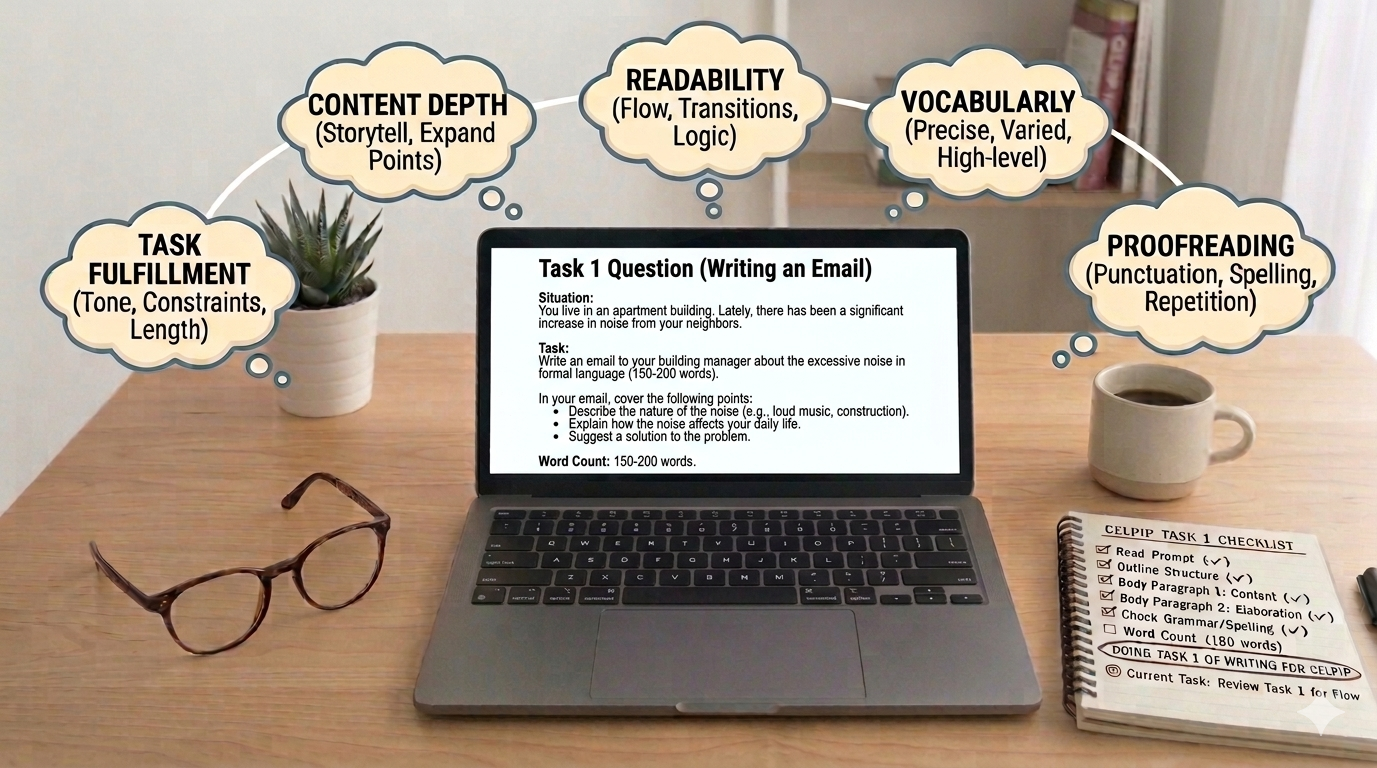
Stop Guessing, Start Writing: The Blueprint for a Level 11 CELPIP Task 1.
Stop guessing what the examiners want. Learn how to decode the three email types: Formal, Semi-Formal, and Informal, and master the advanced vocabulary and structural secrets needed to secure a Level 11 in CELPIP Writing Task 1.
Most students fail to hit a Level 9+ because they treat every email the same. But Task 1 is a test of your social adaptability. Are you a professional tenant? A helpful colleague? Or a friendly cousin?
Today, we’re cracking the 'Tone Code' so you never misidentify a task again.
1. The Three 'Personalities' of Task 1
In the CELPIP world, Task 1 isn't just one thing. It's a chameleon. You need to identify your audience in the first 10 seconds.
The Formal Task
You're writing to someone with a title (Manager, Editor, City Council). No slang, no 'don'ts,' and plenty of respect.
Tone: Respectful, Professional, Formal
👉 Deep dive →
The Semi-Formal Task
You're writing to someone you know, but there's still a professional boundary (a neighbor or a team lead).
Tone: Friendly, Professional, Balanced
👉 Deep dive →
The Informal Task
You're writing to a friend or family member. This is the only place where you can, and should sound like yourself!
Tone: Casual, Natural, Authentic
👉 Deep dive →
2. How You're Actually Scored (The CELPIP 11 Requirements)
Examiners don't just check if your email is "correct." They're looking for four specific elements. Click to expand each criterion:
Content (The "Story")+
What it means: Did you expand on the prompts with specific, vivid details?
❌ Level 7: "There is a noise."
✅ Level 11: "There is a persistent low-frequency humming from the ventilation system that disrupts concentration during work hours."
Vocabulary (The "Precision")+
What it means: Do you use high-level verbs and precise nouns?
- Swap: "Good" → "Exceptional"
- Swap: "Problem" → "Complication"
- Swap: "Fixed" → "Resolved"
- Swap: "Help" → "Assist" or "Support"
Readability (The "Flow")+
What it means: Do you use "signpost" words that connect your ideas smoothly?
- To add: Furthermore, Moreover, In addition
- To contrast: However, On the other hand, Nevertheless
- To show cause: Consequently, As a result, Therefore
- To explain: Specifically, In other words, For instance
Task Fulfillment (The "Vibe")+
What it means: Does your email match the emotional tone of the task?
- If it's a complaint: Were you firm and clear about the issue? Or did you sound apologetic?
- If it's a thank you: Were you sincere and grateful? Or did you sound robotic?
- If it's a request: Did you sound respectful but confident?
3. The Transformation (See the Difference)
The Scenario: You want to volunteer at a local library.
- Explain why you want to volunteer.
- Describe your relevant skills.
Level 7 (Functional)
"I want to help at the library because I like books. I am good at organizing things and I am very friendly to people."
Feedback: It's correct, but "plain."
Level 11 (Expert)
"I have long admired the library's role in our community, and I am eager to contribute to your literacy programs. My background in administrative organization ensures I can manage the cataloging system with high precision."
Feedback: Uses high-level verbs (contribute, manage, ensure) and complex sentence structures.
Notice the difference? Level 11 isn't about writing more, it's about choosing stronger words and showing that you understand the context. You're not just sending an email; you're demonstrating professional communication.
4. Your Step-by-Step Strategy
Stop overthinking it. Follow this proven recipe to transform your Task 1 response in under 30 minutes:
- Analyze (2 mins)
Who is the audience? A boss, a neighbor, or a friend? Pick your tone right away and stick with it. This decision shapes every word you write.
- Brainstorm (3 mins)
Think of one "extra detail" for each bullet point to show depth. Instead of "I am organized," write "I organize files using a color-coded system and maintain a spreadsheet for tracking."
- Draft (15 mins)
Use your memorized opening and closing phrases. Don't waste time trying to be creative; structure first, polish later. Write freely without stopping to edit.
- Proofread (7 mins)
Check for "Word Repetition." Did you use the word "help" five times? Change three of them to "assist" or "support." Also scan for grammar and punctuation.
Pro tip: Practice this timeline under timed conditions. When you sit for the actual CELPIP, your muscle memory will kick in, and you won't panic.
Word count matters: While the requirement is 150–200 words, a Level 11 response usually sits comfortably around 180–190 words, long enough to show off vocabulary, but short enough to avoid making grammar mistakes.
Conclusion & Next Steps
Now that you have the blueprint, it's time to master each specific style. Don't leave your score to chance.
Every point in this guide, the tone shifts, the lexical range, the logical bridges, these aren't just rules. They're the language of professional communication that examiners recognize and reward. Start applying them in your next practice session, and watch your confidence grow.
Ready to go deeper?
Master the Formal Email Format: Rules & Structures- Learn the professional vocabulary, greetings, closings, and tone shifts that examiners reward.
The Semi-Formal Balance: Professional & Friendly- learn to walk the line between respect and rapport.
Informal Writing: Letting Your Personality Shine - show your authentic voice without overdoing the slang.
Related Articles

How to Write a Level 11 Formal Email: Beyond the Basics
Don't leave your score to chance. Learn how to identify formal scenarios instantly and use our 'Expert Vocabulary Vault' to impress examiners with every word you write.

CELPIP Writing Task 2: Master the Pivot Technique
Learn the pivot for CELPIP Writing Task 2: acknowledge one strength of the other option, then show why your choice still wins—without sounding indecisive.
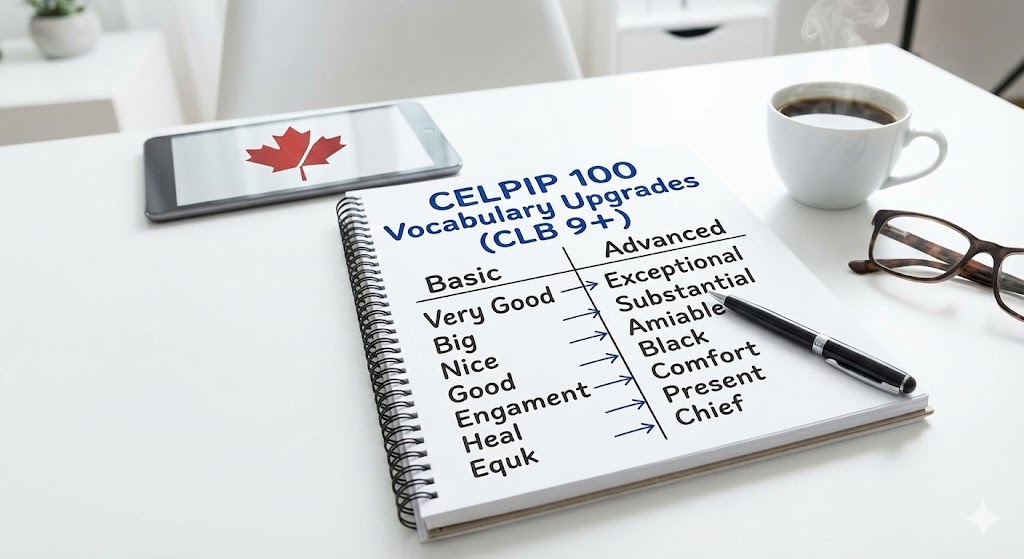
100 Vocabulary Upgrades to Hit CLB 9+ in CELPIP Speaking & Writing
Stop repeating the same vague words. Here are 100 task-grouped vocabulary swaps for CELPIP Speaking and Writing—aim for precision and range, not complexity for its own sake.