The Semi-Formal Secret: Mastering CELPIP Task 1 Relationships
Stop sounding like a robot to your neighbors and colleagues. Learn how to balance professional respect with a friendly tone to hit Level 11 in every semi-formal scenario.
Semi-formal is where most CELPIP test-takers stumble because they don't know if they should sound professional or friendly.
The truth? Semi-formal is both. It's about knowing your relationship well enough to use their first name and relax a little, but still caring enough to respect their time and space.
Today, we're going to unlock the semi-formal voice that earns you points with neighbors, colleagues, and coaches.
1. The 'Vibe' Check: When to Go Semi-Formal?
Semi-formal is the middle ground. Not your best friend, but not a stranger either. Use these quick signals to know when semi-formal is your lane:
- Do I know their first name?Yes → Semi-formal
- Do I see them regularly?Yes (but not daily) → Semi-formal
- Have we had casual conversations?Yes → Lean semi-formal
Your colleague: asking for a shift swap or help with a project
Your neighbor: addressing a shared fence or a noise issue
Your coach or club leader: inquiring about a sports team or activity
Your apartment manager: maintenance or lease questions (not urgent legal matters)
Semi-formal = "Polite enough for work, friendly enough for a coffee."
2. The 'Golden Rules' of Semi-Formal Writing
These three rules are your safety net. Master them and you'll sound warm without sounding unprofessional.
Rule #1: Partial Contractions Are Your Friend
Unlike formal writing, contractions like "I'm" and "can't" are totally okay in semi-formal emails. They make you sound human, not robotic. Use them naturally, don't force them, but don't hide them either.
Too stiff: "I am writing to inquire about the noise from your apartment."
Just right: "I'm reaching out about the noise we've been hearing from your apartment."
Rule #2: First-Name Basis Is Actually Important
Use "Hi [First Name]," or "Dear [First Name]," not their last name. Using "Mr./Ms. [Last Name]" here can actually make you sound too cold and may lower your tone score. You've earned the first-name privilege; use it.
Greeting: Hi Sarah, or Dear Carlos,
Avoid: Dear Ms. Johnson, or To Whom It May Concern,
Sign-off: Best, or Looking forward to hearing from you,
Rule #3: The Softened Ask (Collaboration, Not Commands)
Instead of demanding action, frame your request as collaboration. Use phrases like "I was wondering if..." or "Could we possibly..." This shows respect while staying friendly.
Demanding: "I need your help with this project."
Collaborative: "I was wondering if you could possibly help me with this project when you have time?"
Semi-formal = friendliness with boundaries. You're saying "I like you enough to be casual, but I respect your time."
3. The 'Soft-Skills' Vocabulary Vault
Here's the side-by-side swap guide that shows the difference between sounding cold, just right, or too messy:
| Too Formal/Cold | Semi-Formal (Just Right) | Too Informal/Messy | ||
|---|---|---|---|---|
| I am writing to inquire... | → | I'm just reaching out to ask... | → | Hey, what's up with... |
| I would appreciate it if... | → | Would you mind if... | → | Can you just... |
| Please rectify this matter. | → | Could we look into fixing this? | → | Fix this for me. |
| I trust you will handle this. | → | Let me know what you think when you get a chance. | → | Lemme know ASAP lol |
| Sincerely, | → | Best regards, or Best, | → | See ya, or Cheers! |
Strategy: Pick two or three "semi-formal starters" and rotate them across different emails. This variety shows adaptability and keeps examiners from suspecting a canned template.
4. The Master Template: Your 'LEGO' System
Semi-formal has a rhythm just like formal, but it's warmer and more collaborative. Use these four building blocks as your foundation. Think of them as LEGO bricks you can assemble in different ways.
- The Friendly Opener(1-2 sentences)
Task: Start with warmth. Show you respect their time and are a real person.
"Hi [Name], I hope you're having a great week."
Mention something they'd recognize: the season, a shared project, or just acknowledging their well-being. - The Pivot(1-2 sentences)
Task: Transition smoothly from warm greeting to your actual ask. Use "I'm just reaching out because..." or "I wanted to check in about..."
"I'm just reaching out because..." or "I wanted to check in about..."
This bridges formality and friendliness. It says "I have something to discuss, but I'm not demanding."
- The Collaboration (The Meat)(2-4 sentences)
Task: Expand your request using specific details from the prompt. Frame it as something you're solving together, not something you need them to fix for you.
"Since we both use the shared driveway, I thought it might be best to..."
Show you understand their position and how solving this helps both of you. - The Gentle Closer(1-2 sentences)
Task: End by giving them permission to take time and leaving dialogue open. Show you value their response.
"Let me know what you think when you have a moment. Looking forward to hearing from you."
Sign off with: Best, or Best regards, [Your first name]
Pro tip: These four blocks stay the same structure, but you swap the details. That's the LEGO principle- same frame, endless combinations.
5. The 'Passive-Aggressive' Trap: A Mentor's Real Talk
The neighbor scenario is where semi-formal writers most often slip into passive-aggressive tone. Here's how to stay balanced:
You're writing to your neighbor about their barking dog. You're frustrated. But if you go too formal, you sound like you're suing them. If you go too informal, you sound like you're yelling.
The Level 11 secret? Use "Shared Benefit" language: explain how fixing the problem helps both of you, not just you.
Three ways to sound collaborative instead of angry:
"Your dog has been barking constantly and it's making it impossible to sleep."
"I've noticed your dog's been barking more lately. I'm sure managing that can be stressful for you too. I was wondering if we could brainstorm solutions together, maybe a training tip or a noise barrier that works for both of us?"
- Acknowledge their side: "I'm sure managing that can be stressful for you too."
- Show you understand the problem: "I've noticed... and it seems like..."
- Propose a win-win: "Could we work together on..."
- End with respect: "I'd really appreciate your thoughts on this."
The moment you say "I understand this might be hard for you too," you shift from complaining to problem-solving. That's where examiners give you the Level 11 points.
6. How to Know If Your Draft is Ready
Before you submit on test day, run through this checklist. If you check all four boxes, you're ready.
First-name greeting?: "Hi [Name]," not "Dear Mr./Ms. [Last Name],"
At least one contraction?: "I'm," "can't," "we've"- keeps it human
Softened ask language?: "Would you mind..." or "Could we..." instead of commands
Shared-benefit framing?: Show how the fix helps both of you, not just you
Action step: Take the neighbor scenario. Draft it with all four elements above. Then swap one part, maybe make it more formal or more informal, and compare. You'll instantly see where the sweet spot is.
7. Put It Together: From CLB 7 to CLB 11
Semi-formal is the most-used tone in real life. Nail this, and you've covered the majority of Task 1 scenarios. Use the vocabulary vault above to upgrade your swaps, then run your drafts through the LEGO template and the passive-aggressive checklist.
A strong semi-formal email is warmth + respect + specificity + shared benefit. You're not their friend, yet. But you're not a stranger either.
Ready to practice under pressure? Head to writing practice and filter for "semi-formal" or "neighbor/colleague" scenarios. Set a timer, use the four-step template, and edit with three swaps from the vocabulary vault.
Independent CELPIP-style prep only, always adapt language to the exact scenario in your prompt.
One honest habit that compounds: after each semi-formal practice email, highlight one moment where you could have sounded more collaborative instead of demanding. Rewrite just that sentence. That habit alone shifts your tone score.
Conclusion: Master Semi-Formal, Own Task 1
Pick one semi-formal scenario (colleague, neighbor, or coach), set a timer for 8 minutes, and draft using the four-step LEGO template, then edit with three swaps from the vocabulary vault.
Go to writing practice
Semi-formal isn't a mystery, it's a balance. Once you nail the vibe of "friendly but professional," recognize when to use it, and build your shared-benefit toolkit, you'll write semi-formal emails with confidence.
Most CELPIP test-takers spend all their time on formal emails and informal chats. Semi-formal is your edge. Master this tone, and you unlock access to the majority of real-world scenarios.
Practice with the LEGO template : five different semi-formal scenarios this week (colleague, neighbor, coach, etc.).
Once semi-formal feels solid, return to the Task 1 formal guide or explore informal tone - all three sit on the same framework.
Related Articles

How to Write a Level 11 Formal Email: Beyond the Basics
Spot formal CELPIP Task 1 prompts fast, upgrade phrasing with the vocabulary vault, and use a four-step template that still sounds human, without canned language.
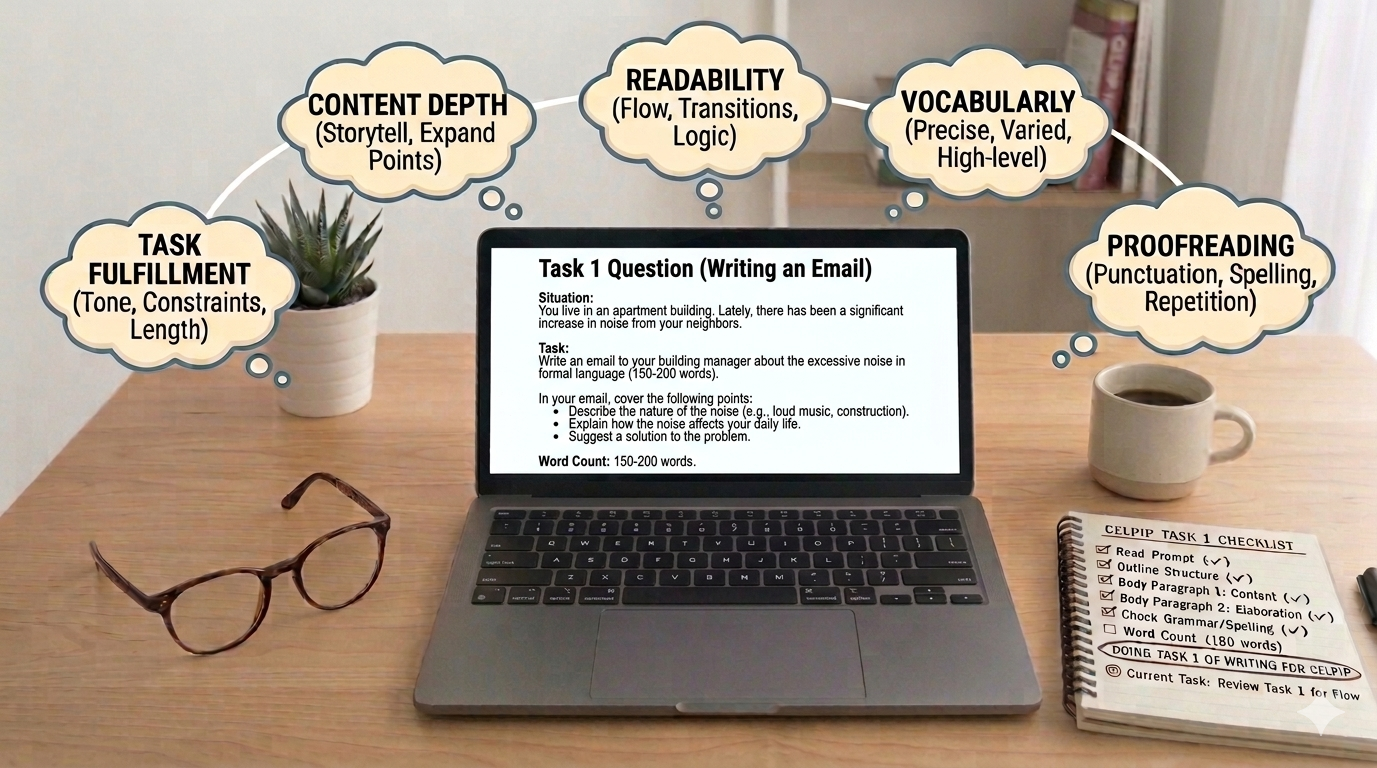
Stop Guessing, Start Writing: The Blueprint for a Level 11 CELPIP Task 1.
Decode formal, semi-formal, and informal Task 1 emails in seconds, see how examiners read content and tone, and follow a timed plan that fits CELPIP-style writing practice.

CELPIP Writing Task 2: Master the Pivot Technique
Learn the pivot for CELPIP Writing Task 2: acknowledge one strength of the other option, then show why your choice still wins—without sounding indecisive.